SUCH LARGE MUCH WOW
From “Can machines think?” to agents that work for you
Eugene Mirotin · Summer Linguistics School · Narva-Jõesuu · 14.07.2026
Part 1
Can Machines Think?
Ideas & key figures, 1950–2022
Part 1 · 1950
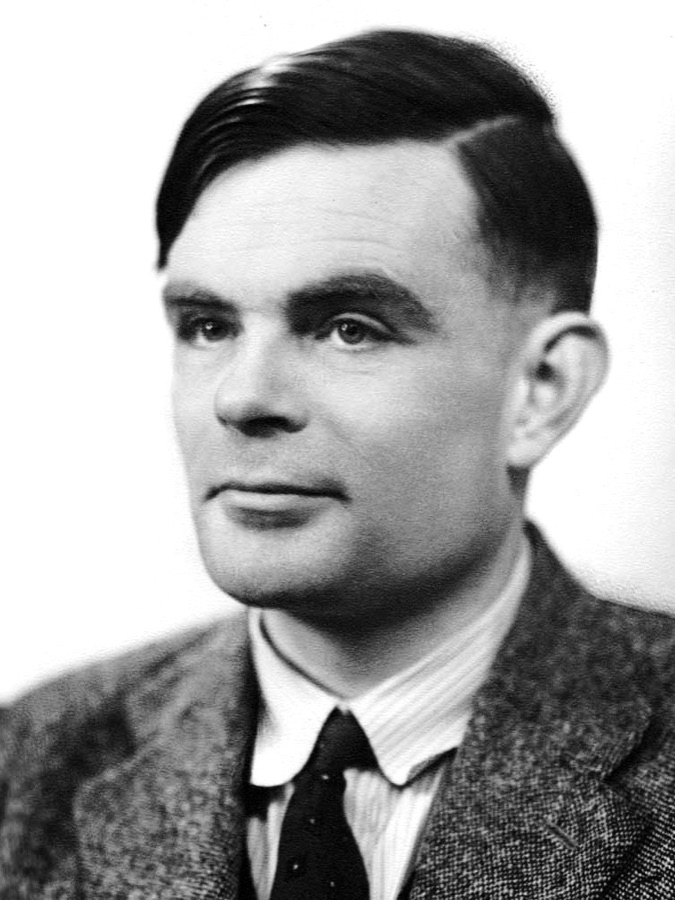
Alan Turing — the question
Alan Turing, 1912–1954
“Computing Machinery and Intelligence” — 1950 proposes the Imitation Game
judge texts two hidden partners — can’t tell? machine passes
Not what is thinking — can it fool you through language alone ?
Linguistics · the Turing Test is a purely linguistic test
Part 1 · 1956
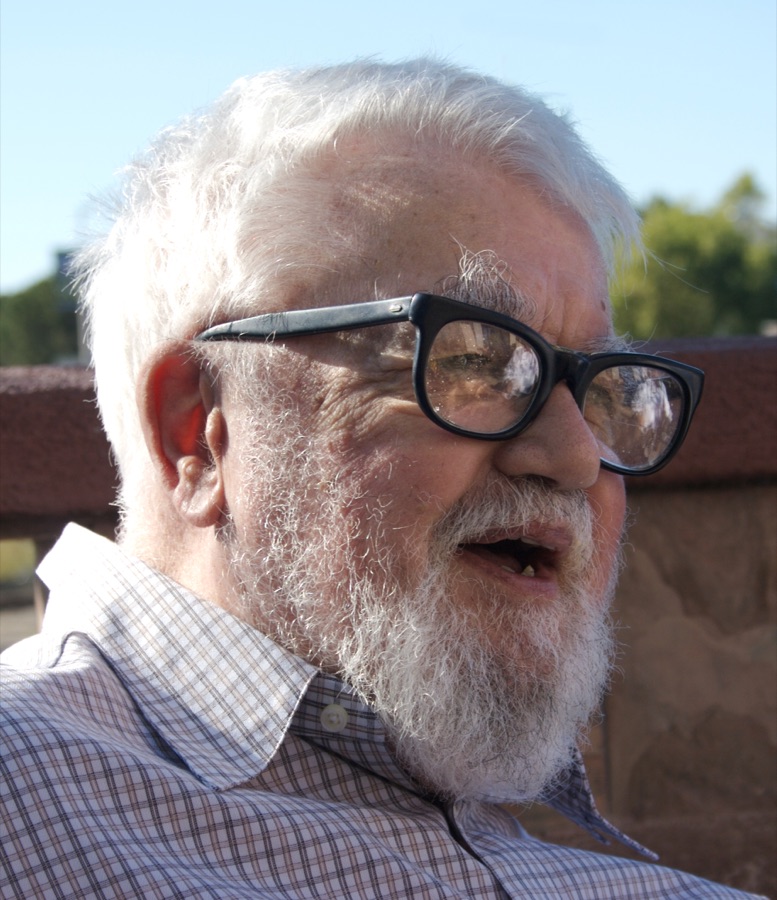
Dartmouth — AI gets a name
John McCarthy
a summer workshop at Dartmouth College
coins the term Artificial Intelligence
the plan: crack it in one summer
AI becomes a field — a name, a community, unlimited optimism
Linguistics · Chomsky’s Syntactic Structures (1957) — the same bet: cognition as a formal system
Part 1 · 1957
The Perceptron — machines that learn
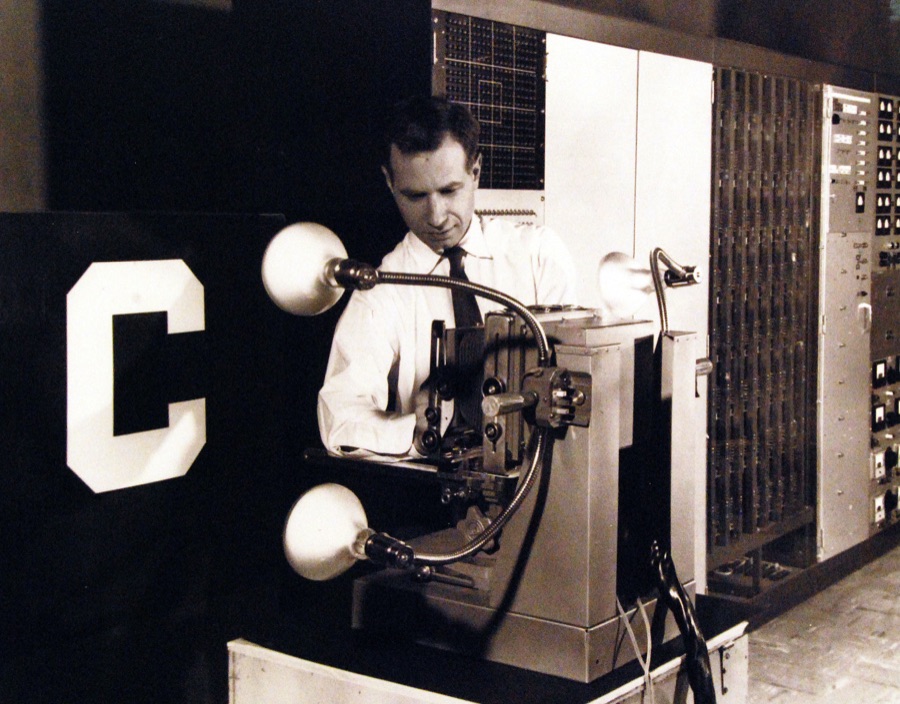
The Mark I Perceptron — US Navy photo
Frank Rosenblatt: not programmed — trained
adjusts its weights on right / wrong feedback
modeled on neurons
…the embryo of an electronic computer that [the Navy] expects will be able to walk,
talk, see, write, reproduce itself and be conscious of its existence.
— New York Times, 1958
Part 1 · 1966
🎯 INTERACTIVE
ELIZA
The first chatbot — a Rogerian therapist. Talk to it.
Part 1 · 1966
ELIZA — the trick
“I feel X ” → “WHY DO YOU FEEL X ?”
a dozen pattern-matching rules — zero understanding
Weizenbaum’s secretary asked him to leave the room
Weizenbaum: disturbed , not pleased
We project understanding onto fluent output
Linguistics · Gricean implicature — hearers infer intent even where none exists
Part 1 · 1969
The first AI winter
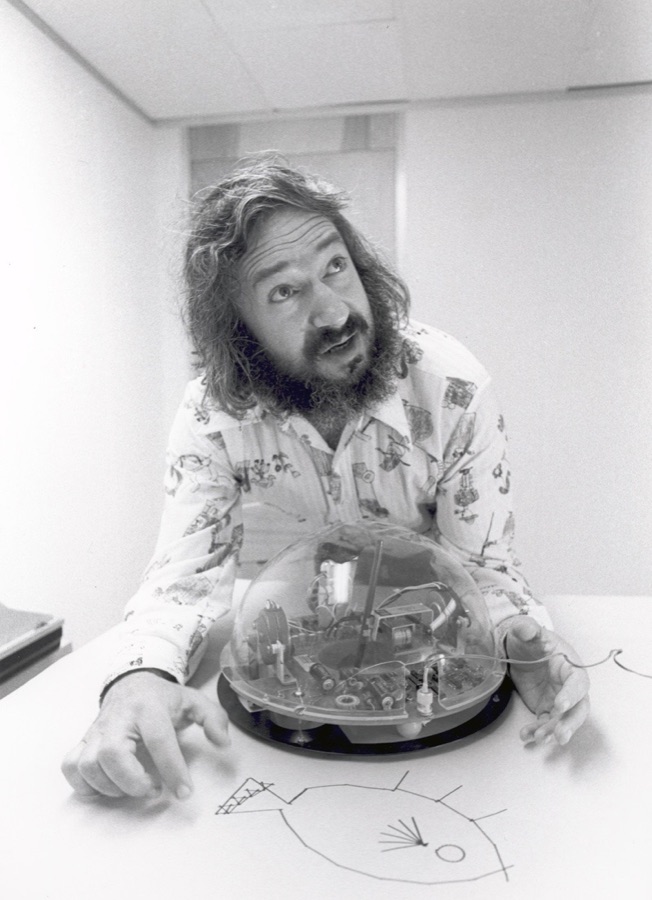
Marvin Minsky
Seymour Papert
Perceptrons , 1969: single-layer nets can’t learn XOR funders read: neural nets = dead end
funding freezes for ~15 years
One rigorous negative result froze a field for a generation
Part 1 · 1980
The Chinese Room
from outside: appears to understand Chinese
你懂中文吗?
question, in Chinese — “do you understand Chinese?”
🧍 📖
a person + a rulebook
当然懂!
answer, in Chinese — “of course!”
inside: follows rules — understands nothing
Syntax ≠ semantics — Searle, 1980
Hold this question — in 45 minutes you’ll see exactly what LLMs do in there
Linguistics · can meaning arise from pure form?
↓ look closer
Part 1 · 1986
Backpropagation — the answer
Geoffrey Hinton
Rumelhart, Hinton & Williams — Nature , 1986
multi-layer networks can be trained
Minsky’s objection — answered
The algorithm was ready in 1986. The data and compute weren’t — wait 25 years .
Hinton — Nobel Prize in Physics, 2024
Part 1 · 1990s
Data beats rules
machine translation: stop parsing, start counting
corpus probabilities replace hand-written rules
Every time a linguist left the group, speech recognition got better
attributed to Fred Jelinek, IBM — wording and date disputed
Empiricism’s first industrial win
Linguistics · Chomsky’s innate structure vs learning from data — round one to the data
Part 1 · 2012
AlexNet — deep learning wins
2010
2011
2012 · #2
2012 · AlexNet
Krizhevsky, Sutskever & Hinton — again
what converged: data + compute + tricks
After 2012 deep learning eats everything: vision, speech, translation. Language is next.
↓ enter 2012
Part 1 · 2013
Word2Vec — meaning becomes geometry
king − man + woman ≈
?
queen
Mikolov et al., Google , 2013
trained to predict a word from its context
byproduct: meaning as geometry
“You shall know a word by the company it keeps ” — Firth, 1957
Linguistics · distributional semantics becomes operational — we’ll play with it in Part 2
↓ solve it
Part 1 · 2017
The Transformer
“Attention Is All You Need”
Vaswani et al., 2017 — Google + University of Toronto
throws away recurrence — attention only
every token sees every token , at once
parallel → scalable
Every major model since is a Transformer: GPT, Claude, Gemini, LLaMA
the architecture itself — next section
Part 1 · 2018–2022
GPT → ChatGPT
2018
GPT-1 — proof of concept
2019
GPT-2 — withheld, misuse fears
2020
GPT-3 — 175B, few-shot
2022
ChatGPT — 100M users in 2 months
today: GPT-5.5 · Claude · Gemini · LLaMA · DeepSeek —
multimodal, agentic
Research curiosity → daily tool
↓ next milestone
Part 1 · 1950 → 2026
76 years in three lines
1950 — Turing: “Can machines think?”
1980 — Searle: syntax is not sufficient for semantics
now — machines talk, often indistinguishably
You’ve seen the questions. Next 45 minutes: what’s actually inside . Then you answer.
↓ next
Part 2
How LLMs Actually Work
From neurons to next-token prediction
Part 2 · Neural nets
The neuron
x₁
x₂
x₃
b
Σ
z
f
y
w₁
w₂
w₃
NEURON
y
=
f
(
w 1
x 1 +
w 2
x 2 +
w 3
x 3 +
b
)
weight = “how much do I care about
this input?”
activation = “fire or stay quiet?”
Sum the evidence, decide to fire
Linguistics · features combining: +voiced, +nasal, +labial → /m/
Part 2 · Neural nets
🎯 INTERACTIVE
Neuron playground
Adjust the weights. Make it fire.
That’s the whole atom of AI . Everything else is many of these .
↓ the point
Part 2 · Neural nets
Layers
“deep”
Input
Hidden
Output
neurons stack into layers
many hidden layers = “deep” learning
each layer: more abstract features
We design the network — the feature hierarchy emerges
characters → morphemes → syntax → semantics
Part 2 · Neural nets
Learning = shrinking the loss
The network guesses. We measure how wrong. Repeat.
predicted: cat 70% · dog 25% · bird 5%
actual: cat ✓
Loss = one number: “how wrong?” —
e.g.
L
=
(
predicted
−
actual
)
2
random weights → terrible loss
goal: nudge every weight downhill
w
←
w
−
η
·
∂
L
∂
w
(η = learning rate)
Backpropagation computes “downhill”
for millions of weights at once
↓ next step
Part 2 · Neural nets
🎯 INTERACTIVE
Gradient descent
Roll the ball to the bottom of the loss valley.
learning rate η
0.10
Step
Auto ▸
Reset
loss = …
Too small: crawls forever . Too big: overshoots . Learning rate is a real dial in real training.
↓ the lesson
Part 2 · Neural nets
We never write rules. Input, correct answer, minimize error — the structure
emerges .
Linguistics · the empiricist bet taken to its extreme (Chomsky is watching)
Part 2 · Transformers
Before attention: reading one word at a time
The
→
cat
→
that
→
the
→
dog
→
chased
→
ran
→
away
by word 8, the signal from word 1 has almost vanished
RNNs read one word at a time
sequential = slow , no parallelism
signal fades with distance
“The cat that the dog that the man bought chased ran away ”
Linguistics · long-range syntax is exactly where RNNs die
Part 2 · Transformers
🎯 INTERACTIVE
Tokenizer
Type anything. Watch it become tokens.
try:
can't
two spaces
12345
Tallinn
GPT-2’s tokenizer, first 6,000 merges — the IDs are real GPT-2 token IDs
Not words, not letters — subwords : frequent chunks
Linguistics · BPE keeps finding morphemes: un-, -iness, -ization
↓ so what are they?
Part 2 · Transformers
Embeddings — words become vectors
king
queen
prince
princess
cat
dog
horse
happy
sad
joy
man
woman
every token → a vector (hundreds–thousands of numbers)
learned , not designedrelated meaning = nearby
Meaning = position in space
distance is similarity; directions are relations
Part 2 · Transformers
🎯 INTERACTIVE
Vector arithmetic
Do algebra on meaning.
−
+
≈
?
king−man+woman
paris−france+germany
walked−walk+swim
actor−man+woman
real 50-dim GloVe vectors, projected to this 2D plane
Gender, tense, capital-of — directions in the space
↓ the point
Part 2 · Transformers
Word order is not free
Dog
bites
man
+ ①
+ ②
+ ③
input = embedding + position
attention reads all tokens at once — order isn’t built in
fix: add a position signal to each embedding
Dog bites man ≠ Man bites dog
Linguistics · word order carries syntax — the model must be told
Part 2 · Transformers
Attention — the intuition
The
cat
sat
on
the
mat
because
it
was
tired
↑ strongest
For every word: which other words matter right now? That highlighting is attention — the whole trick.
Part 2 · Transformers
Attention — the mechanism
Q uery
“what am I looking for?”
every token asks; every token answers; the match decides who informs whom
Attention = softmax(Q ·Kᵀ / √d) · V
match questions to offers, blend the answers
↓ next piece
Part 2 · Transformers
🎯 INTERACTIVE
Attention, live
Click a word — see what it looks at.
pronoun
word sense
pragmatic
GPT-3 runs 96 layers × 96 heads of this — frontier models repeat the idea at larger, often unpublished scales
Linguistics · grammatical relations rediscovered, no linguist involved
↓ how big does this get?
Part 2 · Transformers
The block
self-attention — gathers context
↓
feed-forward — digests it
× 96 (GPT-3)
attention gathers context
feed-forward digests it
stack deep — abstraction grows per
layer
That’s the entire architecture. No parser, no grammar module —
this block, repeated .
Part 2 · Transformers
Three flavors
⟷
Encoder — BERT
reads both directions → understanding
→
Decoder — GPT
left-to-right → generation
⇄
Both — T5
read fully, then generate → translation
Comprehension vs production , in silicon
Part 2 · GPT
The causal mask
The cat sat on
The
cat
sat
on
rows may look left, never right
each token sees only its past
generation can’t peek ahead
“The horse raced past the barn fell ”
Linguistics · left-to-right commitment, like human speech — garden paths hurt us both
Part 2 · GPT
The whole objective
P( next token | everything so far )
at every step: a probability for each of ~100,000 tokens
Everything GPT appears to be emerges from this one objective , at scale
Shannon (1948) framed language statistically: next-symbol uncertainty. GPT is that, done absurdly well.
↓ that’s it?
Part 2 · GPT
Pre-training (GPT-3)
months
× thousands of GPUs
$ millions
one training run
self-supervised — the next token is the label
no annotators, just text
Grammar, facts, style, “reasoning” — side effects of prediction
later flagships: sizes and token counts often unpublished
Part 2 · GPT
Scale does something strange
same task — arithmetic, translation, multi-step reasoning — across GPT-3-family sizes:
125M weights brittle — arithmetic mostly fails
13B weights sometimes works — unreliable
175B weights reliable enough to feel new
Nobody added a reasoning module. At enough scale, better prediction starts to look like reasoning .
↓ scale up
Part 2 · GPT
The alignment problem
raw model
plausible ≠ true toxic, dangerous, confidently wrong
capability without values
aligned model
helpful — follows instructionshonest — admits uncertaintyharmless — declines harm
A brilliant author with no editor and no conscience. Alignment hires the editor .
Part 2 · GPT
RLHF — teaching taste
model writes
three answers: A, B, C
human ranks
B > A > C — just compares
reward model
learns to predict the taste
optimize
generate toward higher reward
leash
don’t drift from the base model
comparing is easier than composing — RLHF
exploits that asymmetry
Preferences,
distilled into a training signal
Linguistics · pragmatic competence on top of grammatical —
Chomsky → Hymes
↓ next step
Part 2 · GPT
🎯 INTERACTIVE
Temperature
Watch it choose the next word.
“The meaning of life is”
“Once upon a time”
temperature
0.70
Sample
Auto ▸
Reset
T→0 : boring and safe · T≈1 : alive · T→2 : word salad
↓ the dial
Part 2 · GPT
What it can’t do
🎭
Hallucinations
plausible ≠ true — the default failure
🌍
No grounding
never seen, touched, lived
🪟
Context window
finite attention span
🫙
No memory
every chat starts blank
📅
Cutoff
history ends at training day
Fluent, grammatical, appropriate —
and unanchored
Linguistics · Searle’s room again — now you know the mechanism
Part 2 · GPT
The full stack
+ scale + RLHF
machines that converse
+ attention
machines that use context
neurons + backprop
machines that learn
Under it all: one probability distribution over the next token . Everything else is emergent.
↓ stack it
Part 3
Giving It a Body
From head in a jar to agent
Part 3 · Model
A genius brain — knows a lot, speaks brilliantly. But locked in glass: it can’t act on its own
In essence — the world’s smartest autocomplete .
Part 3 · Tools
🦾
Tools
hands: not just say — do
“If I were you, I’d call the bank”
search the web · read files · send email · run code
From “you should…” to “done ”
Linguistics · Austin — from saying to doing things with words
Part 3 · Memory
📓
Memory
an external notebook
you explain everything from scratch, every time
a stranger
knows who you are, what you discussed, how you like things
an assistant who knows you
“I remember you prefer formal tone” = reading a sticky note , not recalling an experience
Part 3 · Skills
🎓
Skills
pre-packaged know-how for typical tasks
If tools are hands , skills are a profession
A surgeon and a pianist — same hands, different skills
Physically — a folder of instructions and templates.
Part 3 · Wrappers
👔
Wrappers
a costume and a workplace for the same head
medical AI
legal AI
business assistant
The main part of the costume — the hidden prompt : you sent one sentence, the head received two
pages
“100,000 AI tools” — a handful of heads , dressed 100,000 ways
Part 3 · Agent
🤖
Agent
a model with a body — and the right to act
chat
single exchange
question
→
answer
→
stop
next step you decide
on error you retry
agent
working loop
think
→
act
→
observe
→
repeat
next step it decides
on error it retries
Not “ask AI” — “delegate to AI”
The difference between a consultant and an employee
↓ next
Part 3 · The system
The whole map
Not a “magic neural net” — a carefully assembled system of parts
Parts 1 → 3
90 minutes in three lines
Part 1 — 70 years of asking: can machines think?
Part 2 — the machinery: attention, prediction. Elegant math, no magic
Part 3 — model + tools + memory + loop = agent
It predicts tokens. No body, no experience, no grounding. And yet — it writes, it reasons, it acts.
Understanding — or the greatest symbol-manipulation trick ever built? That’s a question for linguists.
That’s you.
↓ next
Questions?
The whole field started with one — ask yours
←
→